CCS Analysis Informs Maryland Load Growth Responses
March 13, 2026. Recent increases in Maryland electricity prices during winter months, coupled with significant increases in forecasted energy prices attributed to load growth from data centers and AI, have heightened concerns about energy cost impacts and monthly utility bills. These trends have triggered major new interest in solutions to control costs and generate economic stability.
In response to this new environment, some Maryland policy makers have advocated rolling back current system benefit charges (energy surcharges on monthly bills used for reinvestment in energy efficiency and renewable energy) by redirecting funds to consumer rebates. Others have suggested that funds could be reinvested through affordable financial mechanisms (such as low-cost loans) to enable households and businesses to install permanent energy saving equipment and technology that might yield even greater cost savings and economic benefit.
To support evaluation of these choices and answer questions about the best options for return on investment, the Center for Climate Strategies (CCS) prepared analysis for the Maryland Clean Energy Center (MCEC) regarding options for strategic energy and economic investments in the state. The analysis examined the relative value of several categories of energy efficiency and solar investments through low-cost loans and comparing their economic and energy impacts with a $40 electricity rebate such as was provided to Maryland households last year. Results were provided by MCEC Executive Director Kathy Magruder to the Maryland General Assembly on March 3, 2026, in relation to House Bill 1040.
The CCS analysis evaluated how comparable levels of investment from rebates versus low-cost loans could translate into measurable energy savings and economic value across a range of clean energy measures commonly deployed in Maryland energy programs. The analysis considered several “model” energy efficiency and solar projects, assuming typical project costs and energy savings or generation.
The analysis examined six investment types:
• Commercial HVAC and lighting upgrades
• Single-family energy efficiency improvements
• Single-family rooftop solar
• Multifamily solar installations
• Community solar projects
• Commercial and institutional solar deployment
The objective was to provide a straightforward comparison between a one-time consumer stimulus payment and the potential long-term value generated by investments that reduce electricity costs and expand clean energy generation in Maryland.
The topline takeaway is that the $50 million capital allocation has a 1.86 return on investment in just energy cost savings, and a 3.99 ROI when avoided GHG emissions are considered. Every $1 of MCEC funds leverages $2.60 in net consumer savings, compared to a one-time $40 rebate that disappears after one month's bill. Other key findings from the analysis include:
Residential and commercial energy efficiency upgrades generate lasting bill reductions, delivering as much as $29,000 in net lifetime savings per home and approximately $20 million per year in commercial energy cost reductions at full deployment. Commercial HVAC and lighting upgrades, as well as residential efficiency improvements, can reduce energy consumption quickly while lowering electricity bills for households and businesses.
Residential and community solar pays for itself; homeowners who install a system today can reduce their bill by more than 30% over the life of the system. Distributed solar systems, including rooftop solar and community solar, generate long-term electricity value that can exceed the short-term benefit of direct stimulus payments.
Commercial and institutional solar reduces operating costs for businesses, schools, and nonprofits, buildings where energy is a significant overhead cost and where savings free up resources for core missions rather than utility bills. Solar deployment at commercial and institutional facilities can reduce operating costs while supporting Maryland’s clean energy industry and workforce.
Funded projects are expected to result in total savings shown in the chart below based on current MCEC budget allocation assumptions.
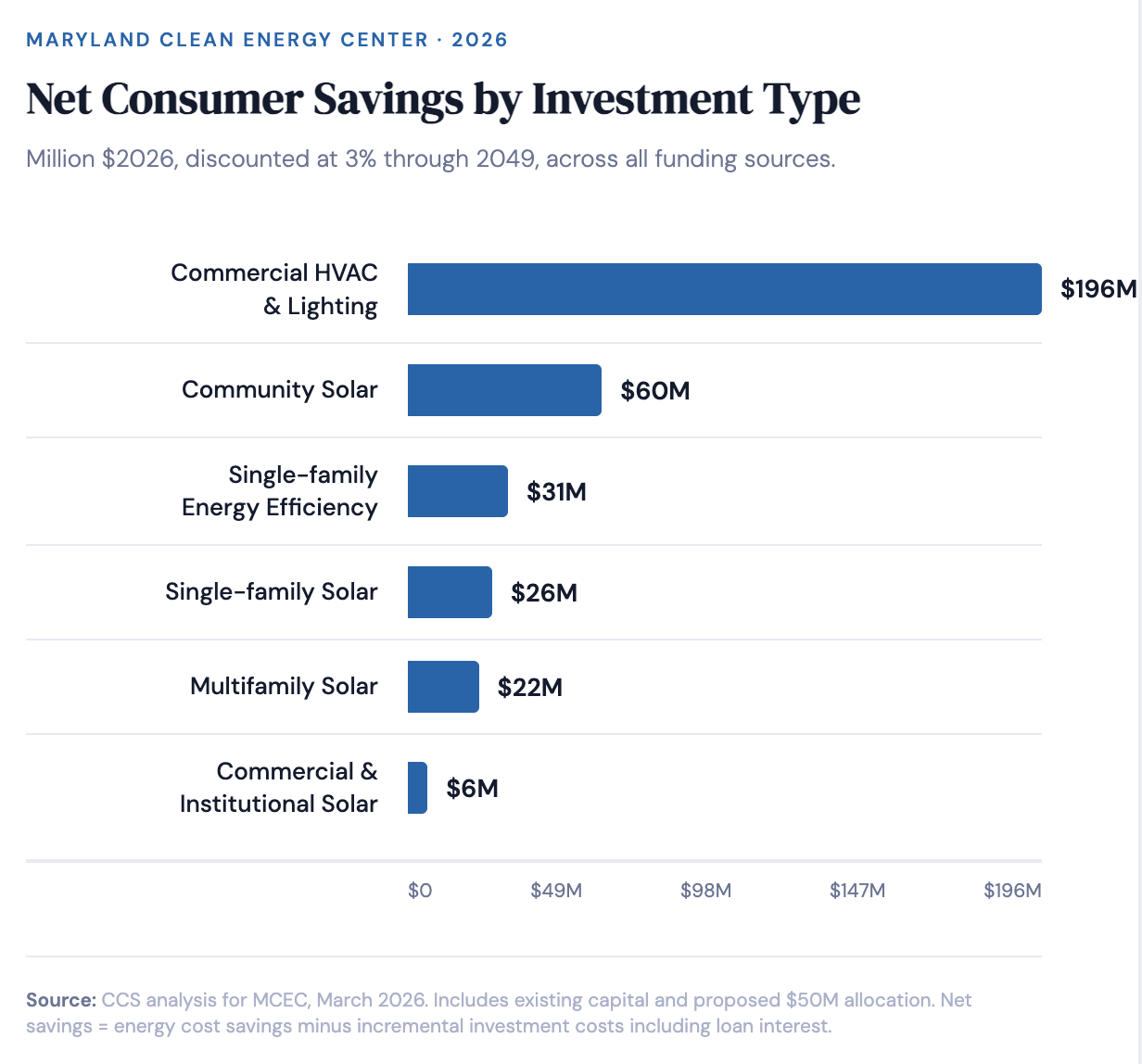
The analysis highlights how targeted clean energy investments can deliver stronger return on investment than energy rebates and by providing durable economic value while reducing electricity costs and supporting Maryland’s climate and economic development goals. By comparing the long-term benefits of energy investments with short-term stimulus distributions, the analysis provides policymakers with investment pathways by which public funds can maximize economic and energy benefits for Maryland residents facing higher power prices.
CCS provides technical assistance, analysis, and tools to governments and stakeholders to address pressing economic, energy, and environmental issues.